

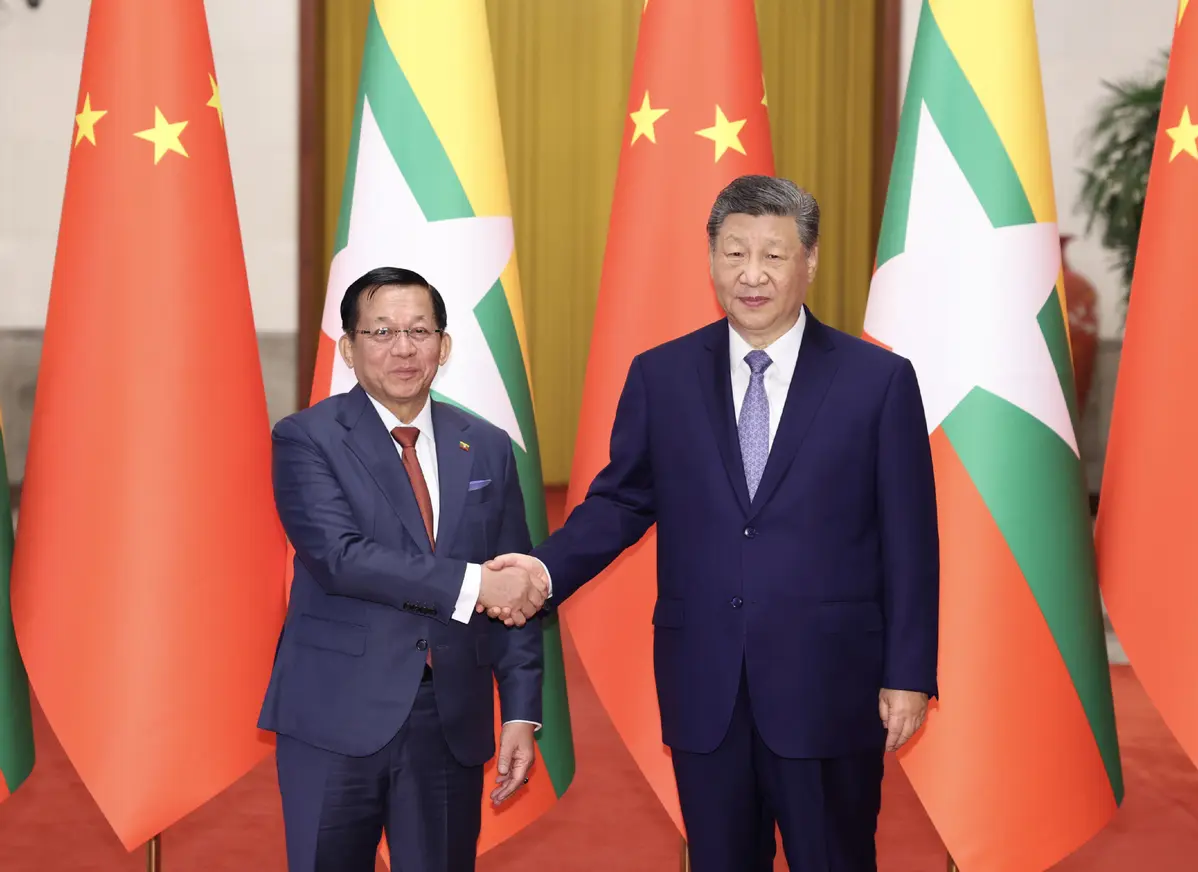
The President of Myanmar, Min Aung Hlaing, is paying a state visit to China from June 15 to 19, in an agenda that includes meetings with the country’s top leadership and the advancement of strategic regional integration projects, with a focus on the economic corridor linking Yunnan Province to the Indian Ocean.
Related: China Leads The 2026 Nature Index Research Rankings
On Tuesday, the Myanmar leader’s main engagement in Beijing was a high-level meeting with Chinese President Xi Jinping at the Great Hall of the People.
During the meeting, Xi said that China is willing to “carry forward the pauk-phaw fraternal friendship” and deepen comprehensive strategic cooperation with Myanmar.
The term pauk-phaw is widely used in diplomatic relations between the two countries and refers to the historical ties of friendship and fraternity that Beijing and Naypyidaw say they have maintained for decades.
“I am willing to work with you to produce more results in building a China–Myanmar community with a shared future,” Xi said.
The concept of a “community with a shared future” holds a central place in China’s foreign policy and is used by Beijing to promote international relations based on long-term cooperation, shared development, and mutual benefit.
During the visit, 18 cooperation agreements were signed in areas such as trade, infrastructure, economic development, and disaster relief, consolidating a new package of bilateral understandings.
In response, Min Aung Hlaing said that “Myanmar attaches great importance to relations with China and is willing to further deepen practical cooperation in various fields and strengthen the friendship between the two countries.”
The Myanmar leader also reaffirmed his country’s support for the One China principle. “Myanmar firmly supports the One China principle,” he said.
The meeting focused on strengthening bilateral strategic cooperation, regional stability, and the continuation of connectivity projects between the two countries.
In addition to the meeting with Xi Jinping, Min Aung Hlaing also met with Chinese Premier Li Qiang and with Zhao Leji, Chairman of the Standing Committee of the National People’s Congress.
The meetings were part of the official state visit agenda and focused on deepening economic, commercial, and legislative cooperation between the two countries.
China–Myanmar Corridor Gains Momentum With State Visit
The main strategic outcome of Min Aung Hlaing’s state visit to Beijing was the advancement of the China–Myanmar Economic Corridor (CMEC), one of the flagship projects of the Belt and Road Initiative, also known as the New Silk Road.
During the meeting with Xi Jinping, both governments agreed to accelerate priority connectivity and infrastructure projects, considered central to bilateral economic integration.
The corridor envisions a link between China’s Yunnan Province and the Indian Ocean, crossing Myanmar along an axis of more than 1,000 kilometers.
The route includes the Muse–Mandalay–Kyaukphyu corridor, with the deep-sea port of Kyaukphyu in Rakhine State seen as a strategic maritime outlet for southwestern China.
The project combines multiple infrastructure components. The Muse–Mandalay–Kyaukphyu railway, still in the planning and negotiation phase, is estimated at around 431 kilometers and has been valued at approximately US$ 9 billion. It is complemented by highways, special economic zones, and an integrated logistics system.
In addition to planned infrastructure, the corridor already includes operational assets. An oil pipeline and a gas pipeline running through Myanmar allow direct energy transport to China, with an estimated capacity of around 22 million tons of oil per year and 12 billion cubic meters of natural gas annually, reducing China’s reliance on maritime routes passing through the Strait of Malacca.
Overall, estimates suggest that the set of projects linked to the corridor could mobilize more than US$ 15 billion in investments over its full development.
For China, the corridor is strategically important as it diversifies access routes to the Indian Ocean and reduces logistical vulnerabilities in sensitive global shipping lanes.
For Myanmar, the project is presented as an opportunity to expand national infrastructure, attract investment, and develop regions along the route.
The signing of 18 agreements during the state visit is seen as a step toward accelerating pending stages of the project and strengthening coordination between the two countries in its implementation.
Author: Bruno Falci
Source: teleSUR English
